
How to get a private well permit in Wake or Johnston County
Who issues the permit, who can drill, where the well can go, how deep Wake wells run, which water tests apply and what each county charges.
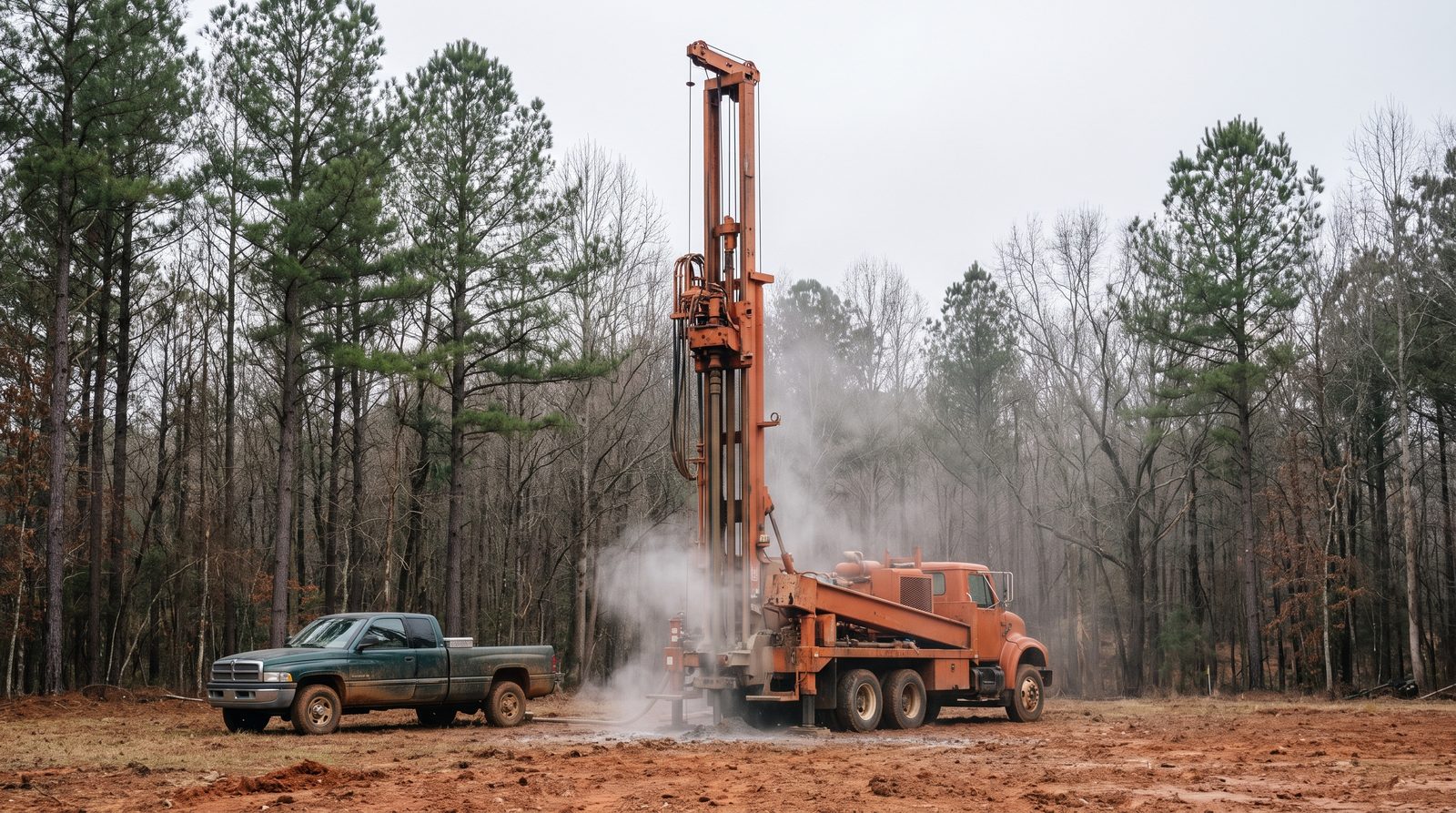
If your lot has no public water, your new house will need a private well, and in North Carolina that starts with a permit from the county health department. A certified contractor drills it, the county inspects it, and the water is tested. Wake County charges $800 for a new-well permit and Johnston County $400, before you pay anyone to drill.
Who issues the permit, and how long does it take?
Under state law, every county health department runs a program to permit, inspect and test private drinking-water wells, and it is the only office that issues well permits. No one may build a well without one. Repairs need a permit too, though repairing or replacing just the pump or tank does not.
Before approving a permit, the health department visits the site. If it finds an old abandoned well, the new permit will require that well to be properly closed. If the lot has or will have a septic system, the application must include a plat or site plan. The law gives the department 30 days to approve or deny; if it does not act, the permit is issued automatically. A permit is good for five years, but can be revoked if the facts it was based on change materially.
In Wake County, Onsite Water Protection handles wells. You apply through the Wake County Permit Portal, which needs an account. If the home also needs septic, the well permit is issued together with the septic permit on the same site plan. Wake lays out the steps:
- The builder, owner or agent applies online with a site plan and the fee.
- Staff check the site for well and septic suitability. If it is suitable, a Construction Authorization (CA) is issued, and the building permit can be issued.
- The well contractor gets a copy of the CA before starting.
- The contractor builds the well and calls for a grout inspection.
- The pump installer calls for a wellhead inspection within 72 hours of finishing. A failed inspection brings a reinspection fee.
- The water is tested.
Wake's well inspection line is 919-856-7481 or wellinspections@wake.gov.
In Johnston County, Environmental Health sites, inspects and permits wells under county rules, including setting a safe distance from contamination sources, observing the grouting and taking water samples. One application covers a septic system or a well; you can mail it, email it to envhealth@johnstonnc.gov or drop it off. The office is at 309 E. Market Street in Smithfield, 919-989-5180, open weekdays 8 a.m. to 5 p.m., and you can check a permit's status online.
Who is allowed to drill the well?
The state keeps a searchable list of certified well contractors you can filter by county. Certified contractors carry a photo wallet card showing the dates their certification is valid, and the state advises asking to see it.
There are four certification levels. Level A covers all well work, including air or mud rotary drilling. Level B covers most work but not rotary drilling. Level C covers grouting and well abandonment, and Level D covers pump installation, repair and well disinfection. In Wake, well contractors must also register with the county every year.
Where can the well go, and how deep will it be?
State construction rules set minimum distances. For a single-family home, a well must be at least 50 feet from the septic tank and drainfield, including the repair area (100 feet for a saprolite system), and 25 feet from the house, including attached garages, patios or decks that need a building permit. Other minimums include 50 feet from ponds, 25 feet from streams, 100 feet from animal barns and 500 feet from most landfills (100 feet from land-clearing and inert-debris landfills). A well may not sit where runoff collects. In most areas the casing (the pipe lining the top of the hole) must reach at least 20 feet down, and it must end at least 12 inches above ground. A plate on the well records its depth, yield and completion date.
How deep? A 2022 USGS study of more than 7,500 wells in and within five miles of Wake County found a median depth of 265 feet, median casing depth of 68 feet and median yield of 10 gallons per minute. Yield generally rose with depth to about 200 feet, then fell, and it varied a lot even within one neighborhood. The study was of Wake County; it gives no figures for Johnston.
What tests must the water pass, and what does it cost?
State law requires a new well to be disinfected, then inspected; only then does the department issue a certificate of completion, and no well may be used without one. Within 30 days after that, the water is tested for a list of metals and minerals, nitrates, nitrites, pH and bacteria, and you get the results.
In Wake, bacteria, inorganic and nitrate/nitrite results must meet standards before the house gets its certificate of occupancy. Bacteria results take about 48 to 72 hours and most others about two weeks. Gross alpha, a radioactivity screen, takes three to four weeks, and Wake says it has "a 1 in 7 chance of requiring treatment and re-testing." Wake also expects one in five wells in eastern Wake to have unsafe natural uranium, radium or radon, and offers an address lookup map.
In Johnston, samples must show no coliform bacteria before the certificate of completion is issued, and radionuclide tests are done only by private labs.
Fees: Wake's $800 permit covers the site review, inspections, sampling and lab work; approving an existing well for a new home is $125, as of October 2026. Johnston's fee schedule, effective July 1, 2025, lists $400 for a well permit and $50 for a reinspection, plus sampling fees such as $29 for total coliform. Repair and abandonment permits are free in both counties.
Afterward, the state recommends testing for bacteria every year. Wake sells optional test packages, including a $140 radiation package plus a $50 trip fee.
Sources
- G.S. 87-97, Permitting and testing of private drinking water wells · NC General Assembly
- 15A NCAC 02C .0107, Standards of Construction: Water Supply Wells · NC Office of Administrative Hearings · June 15, 2020
- Well Permits, Fees and Approvals · Wake County
- Steps to Completing the Permitting and Inspection Process for New Wells · Wake County
- Naturally Occurring Contamination · Wake County
- Available Well Water Tests and Fees · Wake County
- Assessment of Well Yield, Dominant Fractures, and Groundwater Recharge in Wake County, NC (SIR 2022-5041) · USGS
- Private Drinking Water Wells · Johnston County Environmental Health · July 20, 2026
- Applications, Forms, and Rules · Johnston County Environmental Health
- Environmental Health Fee Schedule · Johnston County · July 1, 2025
- Find a North Carolina Certified Well Contractor · NC DHHS Division of Public Health
- Well Contractor Certification Levels · NC DHHS Division of Public Health
- Private Wells: Frequently Asked Questions about Testing · NC DHHS Epidemiology
More on finding land

Finding land
Found a lot you like? What to check before you buy, and who to call
A walk through North Carolina's standard land contract, the checks it lets you make, and the Wake and Johnston County offices that can answer your questions.
Finding land
What is a perc test, and how do you get one for a lot in the Triangle?
How the septic soil evaluation works in Wake, Johnston, Chatham and Franklin counties, what it costs, the private soil scientist option, and what a failed lot means.
Finding land
How to find a Triangle lot's covenants and HOA rules before you buy
Where covenants are recorded in Wake, Johnston, Durham, Chatham and Franklin, what a North Carolina HOA can do, and what a seller must disclose.