
How to build a house in the Triangle, from finding land to moving in
The order of steps, from checking who regulates a lot to the final inspection, and which Wake or Johnston County office handles each one.
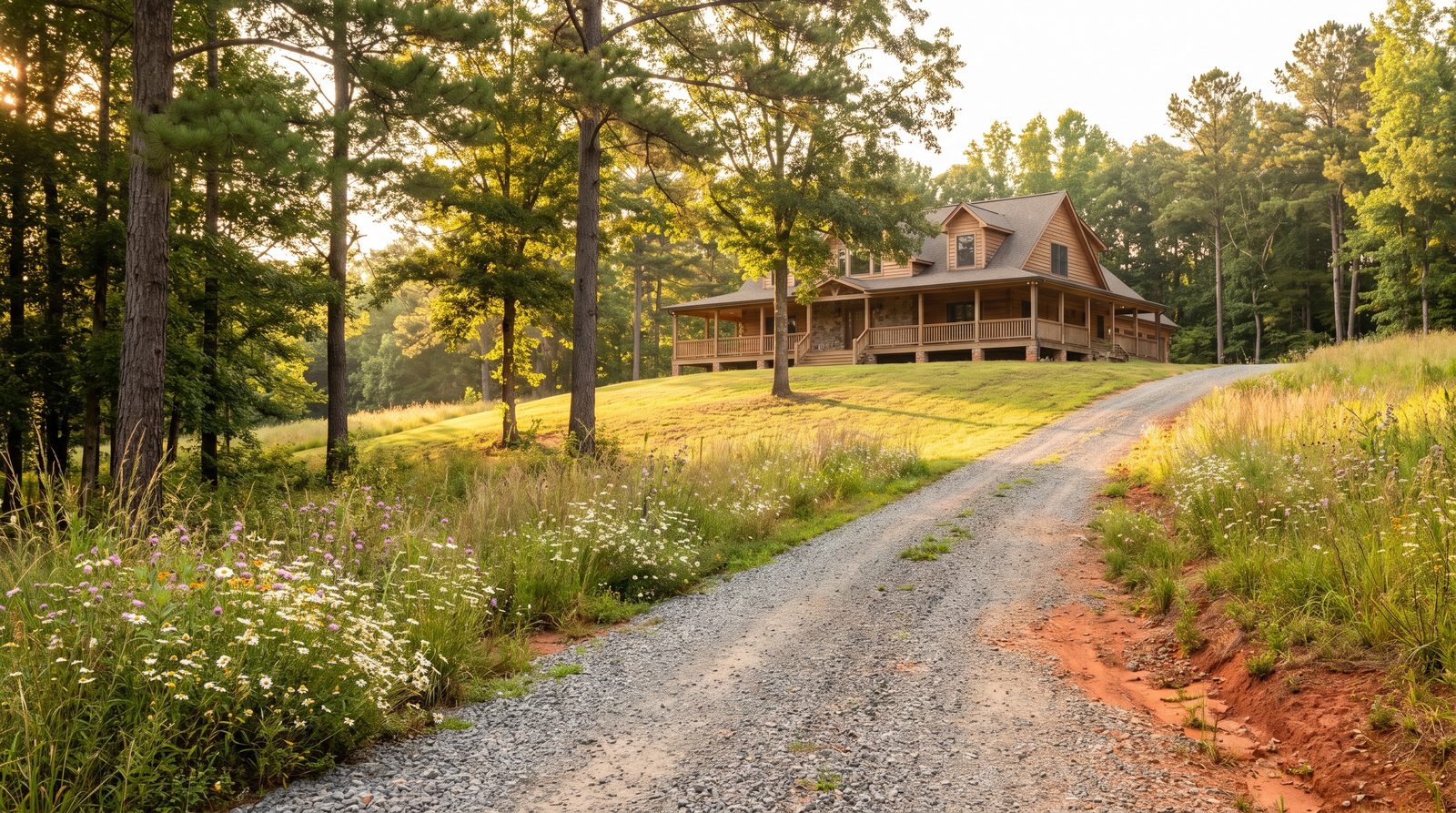
Before you buy land, find out who regulates it, whether it will use septic or public sewer, and whether it can get a well, a driveway and a clean look at the flood maps. After that come permits for septic, well, driveway, land disturbance and the building itself, then a series of inspections ending in a final inspection. Wake County is the main example below, with Johnston County for comparison.
Who regulates the lot you're looking at?
This is the question that sets everything else in motion. Wake County issues septic permits in unincorporated areas, meaning outside city or town limits.
To check, type the address into the county's iMaps tool. Under "GENERAL," the jurisdiction shows as "WC" if the lot is in Wake County's hands.
If the lot is inside a town, Wake County says to call that town's planning department first to learn the order of steps. The county's page links planning offices for Apex, Cary, Clayton, Fuquay-Varina, Garner, Holly Springs, Knightdale, Morrisville, Raleigh, Rolesville, Wake Forest, Wendell and Zebulon. Knightdale, Rolesville, Wendell and Zebulon also use the county's Permit Portal for building permits.
In unincorporated Wake, you start by applying for a wastewater permit and either a building permit or a planning and zoning permit through the Wake County Permit Portal.
In Johnston County, the Land Use/Zoning Permit comes from Johnston County Inspections, or from the town planning office if the lot is inside town limits or the town's extraterritorial jurisdiction (an area just outside town limits where the town's rules can apply).
Can the lot handle septic, a well, a driveway and flood rules?
Septic or sewer. According to Wake's guide to choosing a wastewater permit, a home on public water and sewer (you get a utility bill) needs no wastewater permit. Otherwise, a new home needs a Wastewater Residential Permit. Wake's application instructions call the septic application an Improvement Permit and/or Construction Authorization.
Before county staff visit the lot, Wake's application instructions say you must:
- submit a scaled site plan;
- flag every lot corner and the property lines at least every 50 feet (the county suggests a professional land surveyor if you're unsure where the corners are);
- flag the corners of the planned house, including decks, patios and porches;
- flag buffers and easements;
- clear heavy brush and small trees under 3 inches across, without removing soil.
The county warns an incomplete application "WILL DELAY" processing and may bring a fee for a wasted trip. Staff may dig auger borings (small test holes), so Wake recommends calling 811, which is free, at least three working days ahead. 811 doesn't mark private lines. Questions go to Wake's wastewater information specialist at 919-856-7434 or wastewater@wake.gov.
Well. Wake's Groundwater Protection and Wells Section oversees private wells. You apply through the Permit Portal or through a certified well contractor; contractors register with the county each year, and the county publishes the list.
Flood risk. The state's Flood Risk Information System, run by NC Emergency Management, offers flood hazard maps and data for North Carolina.
Driveway. If you need a new or changed connection to a state road, NCDOT's driveway permit FAQ says you need a permit from the local NCDOT District Engineer's office, and advises contacting your city or county first. NCDOT says there's no application fee, though services such as inspections may carry charges. Simple requests typically take four weeks or less after formal submittal; complex ones can take eight weeks or more.
Which permits come before construction?
In Wake County, you'll generally need these permits before construction:
- Wastewater and well permits, described above. They're separate from the building permit, and the bedroom count on your plans must match the permit application and the septic system.
- Land disturbance permit (erosion control). It's required for any lot in a subdivision, even under 1 acre disturbed, and outside a subdivision when more than 1 acre is disturbed. Apply in the portal under "Land Disturbance – Individual Lot(s)."
- Watershed reviews, if needed. A $50 review may apply if the lot has flood hazard areas, and another $50 review if planned impervious area (roofs, driveways and other hard surfaces) is over the limit.
- Building permit. You'll need a site plan, building plans, contractors' proof of workers' compensation or an exemption affidavit, and for projects of $40,000 or more, an Appointment of Lien Agent through Liens NC. If you're your own general contractor on a project of $40,000 or more, a notarized owner-contractor affidavit is required.
The site plan shows lot lines, road frontage, buildings and their distances from fixed points, driveways, well and septic or sewer connections, water features, buffers, flood-prone areas, and impervious surface in square feet and as a percentage of the net lot. Wake notes a survey from a recent mortgage closing is a good resource.
Johnston County's list is similar: the zoning permit, well and septic permits from Johnston County Environmental Health (or written approval to connect to public utilities), digital construction drawings, a detailed site plan and a form from liensnc.com for jobs of $40,000 or more.
What happens during the build?
Wake's inspection guidance lists the order. It starts with a temporary power pole and a footing inspection, before any concrete is poured. Erosion rules require a gravel or sand construction driveway.
Then come the foundation inspection before backfilling, an under-slab inspection where it applies, electrical, plumbing and mechanical rough-ins, framing once the house is "dried-in," and insulation before walls are covered. Last are the trade finals and the final building inspection, once landscaping drainage and address requirements are met and disturbed areas are seeded and mulched. Wake may require a final "as-built" site plan before a certificate of occupancy.
How long does it all take? Nationally, single-family homes took an average of 7.4 months from start to completion in 2025, according to the Census Bureau. That's a national figure, not a Triangle one, and it doesn't include the land and permit steps.
Sources
- Build a New One- or Two-Family Dwelling · Wake County Government
- Apply for a Permit (wastewater) · Wake County Government
- Choosing the Right Wastewater Permit · Wake County Government
- How to Apply for a Wastewater Permit · Wake County Government
- Groundwater Protection and Wells · Wake County Government
- Inspection Guidance · Wake County Government
- Driveway Permit Frequently Asked Questions · NCDOT
- North Carolina Flood Risk Information System · NC Emergency Management
- Building Permit Requirements · Johnston County Inspections · April 7, 2026
- Average Length of Time from Start to Completion (table) · U.S. Census Bureau / HUD, Survey of Construction
- iMaps · maps.raleighnc.gov
- Wake County Permit Portal · wakecountync-energovpub.tylerhost.net
- Liens NC · liensnc.com