
How big does a septic drain field need to be for a 3- or 4-bedroom house?
North Carolina sizes a drain field by bedrooms and soil, and nearly every lot needs room for a backup field. Here is how it works, and how to learn if your lot fits.
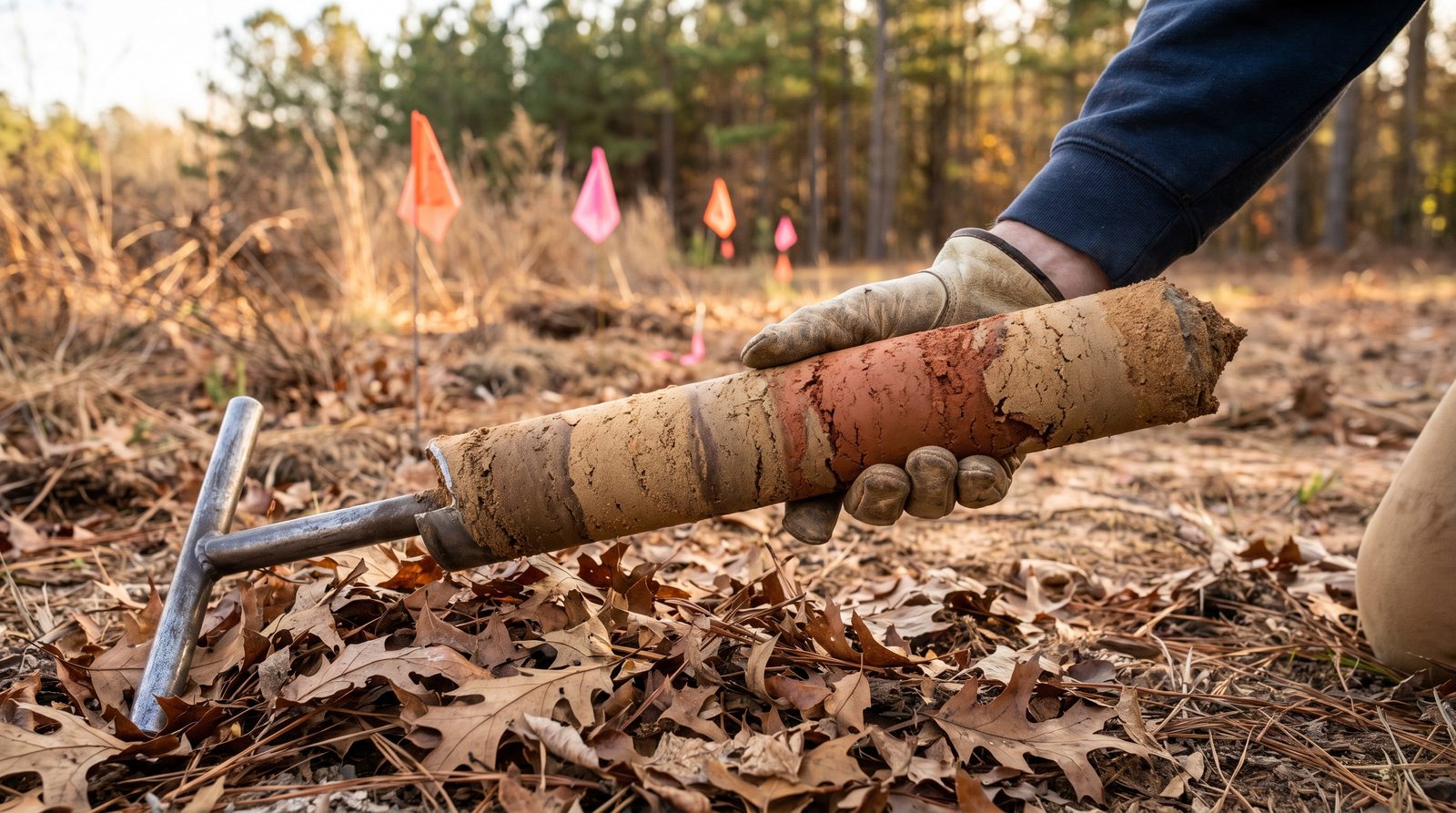
There is no single size for a drain field, the buried trenches where a septic system spreads treated wastewater into the soil. In North Carolina the size depends on how many bedrooms the house has and on the soil the county finds when it evaluates your lot. Your lot also needs room for a second, backup field. So the county's soil evaluation, not the size of the lot, decides whether your house plan fits.
How does North Carolina size a drain field?
It starts with bedrooms. Under the state's design daily flow rule, a home is designed for at least 120 gallons per day for each bedroom, or 60 gallons per day per person when more than two people per bedroom will live there, whichever is greater. That rule took effect January 1, 2024 and was amended effective June 1, 2026.
Doing the multiplication from that rule, a 3-bedroom home works out to 360 gallons per day and a 4-bedroom home to 480 gallons per day. Those are design numbers, not a guess at how much water your family will actually use.
Next comes the soil. The state's dispersal system rule sets a "long-term acceptance rate" for each soil type: how many gallons a day each square foot of trench bottom can take. The rule's ranges are:
- Sands (sand, loamy sand): 0.8 to 1.2 gallons per day per square foot
- Coarse loams (sandy loam, loam): 0.6 to 0.8
- Fine loams (sandy clay loam, silt loam, clay loam and others): 0.3 to 0.6
- Clays (sandy clay, silty clay, clay): 0.1 to 0.4
The formula is simple: the design flow divided by the soil's rate gives the minimum trench-bottom area, and that area divided by the trench width gives the minimum trench length. For a home with a full kitchen, the rate can be no higher than the middle rate for its soil group.
In plain terms, the slower your soil drinks, the more trench you need. The same 4-bedroom house needs far more trench on clay than on sand.
What does the county look at in the soil?
The rule tells the county to weigh soil texture, structure, consistence, wetness, depth, rock content, landscape position, slope and the type of system. For a conventional trench, the rate is based on the most limiting natural soil layer within 12 inches below the trench bottom.
A few basics also apply. You need 12 inches of natural soil between the trench bottom and any limiting layer, such as rock or a seasonal water table. A field that needs cover soil above natural grade can't go on slopes over 30 percent, and that cover soil must spread 5 feet past the trenches. Gutters, downspouts and stormwater must be steered away from the field. Weathered rock, called saprolite, has lower rates, and some kinds may only be used with advanced pretreatment.
NC State Extension says a drain field usually fits in the front or back yard of a typical 1-acre home site, but clayey, slowly permeable soils need a larger field.
Why do you need room for two drain fields?
The second one is the repair area: space set aside in case the first field ever fails. Wake County says the repair area must be big enough for a complete replacement drain field and can't be covered with buildings or pavement. NC State Extension adds that the repair area may need a more sophisticated and more expensive kind of system than the first one.
Both areas also have to respect setbacks. Wake County's FAQ lists general distances of 10 feet from property lines, 15 feet from pools and basements, 5 feet from decks and 50 feet from surface waters. Once you add the house, driveway, a future pool or deck and two fields, a lot that looks roomy can fill up fast.
How do you find out if your lot has enough room?
Ask the county for a soil evaluation and an improvement permit, the permit that says a lot can support a septic system. NC State Extension advises getting one before you buy a lot you plan to build on.
In Johnston County, the Environmental Health office lays out these steps:
- Apply with a document from the planning and zoning office and a site plan showing the house, driveway and setbacks.
- Pay the fees and get assigned an Environmental Health Specialist.
- Rough-stake the area to be evaluated and where the house will go.
- If the property is suitable, have it surveyed and submit a plat if required.
- With zoning and environmental health permits in hand, apply for building permits.
The office is at 309 E. Market Street in Smithfield, 919-989-5180.
In Wake County, applications inside the county's own permitting area usually start with Planning, Development & Inspections; elsewhere, you apply for a wastewater permit on the county Permit Portal. Existing septic permits can be viewed online through the Permit Portal or iMaps. Questions go to the Wastewater Information Specialist at wastewater@wake.gov or 919-856-7434.
Wake's fee page lists a residential improvement permit at $400 (limited to less than 3 acres per evaluation) and a construction authorization, including the operation permit, at $400, for a total of $800. A residential design review fee is $110 and a re-inspection fee, charged for unnecessary return trips on lot evaluations and failed installation inspections, is $200.
Does the septic permit limit how many bedrooms you can have?
Yes. The NC Real Estate Commission explains that permits set a capacity, generally two people per bedroom, and may carry other limits, such as no dishwasher or garbage disposal. Brokers may advertise only the number of bedrooms the permit allows, and the commission notes that adding capacity later may be impossible with no room to expand and no public sewer.
That is why it pays to permit for the house you want, including that fourth bedroom, from the start.
Who to call in your county
Septic and well permits always come from the county's environmental health office, inside town limits or out.
- Wake County: Onsite Water Protection, 919-856-5700
- Johnston County: Environmental Health, 919-989-5180
- Chatham County: Environmental Health, 919-542-8208
- Franklin County: Environmental Health, 919-496-8100
- Durham County: Environmental Health, 919-560-7800
- Nash County: Environmental Health, 252-459-9829
- Granville County: Granville Vance Public Health, Environmental Health, 919-693-2141 (ask for Environmental Health)
- Wilson County: Environmental Health, 252-291-0468
Sources
- 15A NCAC 18E .0401 Design Daily Flow · NC Office of Administrative Hearings (NCAC) · June 1, 2026
- 15A NCAC 18E .0901 General Design and Installation Criteria for Subsurface Dispersal Systems · NC Office of Administrative Hearings (NCAC) · June 1, 2026
- Septic Systems and Their Maintenance (AG-439-13) · NC State Extension · March 6, 2026
- Septic System Permitting FAQs · Wake County
- On-Site Wastewater (Septic Systems) · Johnston County Environmental Health
- Wastewater Fees · Wake County
- Septic Permits – A Refresher · NC Real Estate Commission Bulletin
Get the weekly email
The new guides and news for families building in the Triangle, once a week. Free.
More on finding land

Finding land
Found a lot you like? What to check before you buy, and who to call
A walk through North Carolina's standard land contract, the checks it lets you make, and the Wake and Johnston County offices that can answer your questions.
Finding land
What is a perc test, and how do you get one for a lot in the Triangle?
How the septic soil evaluation works in Wake, Johnston, Chatham and Franklin counties, what it costs, the private soil scientist option, and what a failed lot means.
Finding land
How to get a private well permit in Wake or Johnston County
Who issues the permit, who can drill, where the well can go, how deep Wake wells run, which water tests apply and what each county charges.