
Can you build a backyard cottage or in-law suite on your Triangle lot?
What Raleigh, Durham, Cary, Wake County and the new state law say about ADUs, and what to check before you plan a second home on your lot.
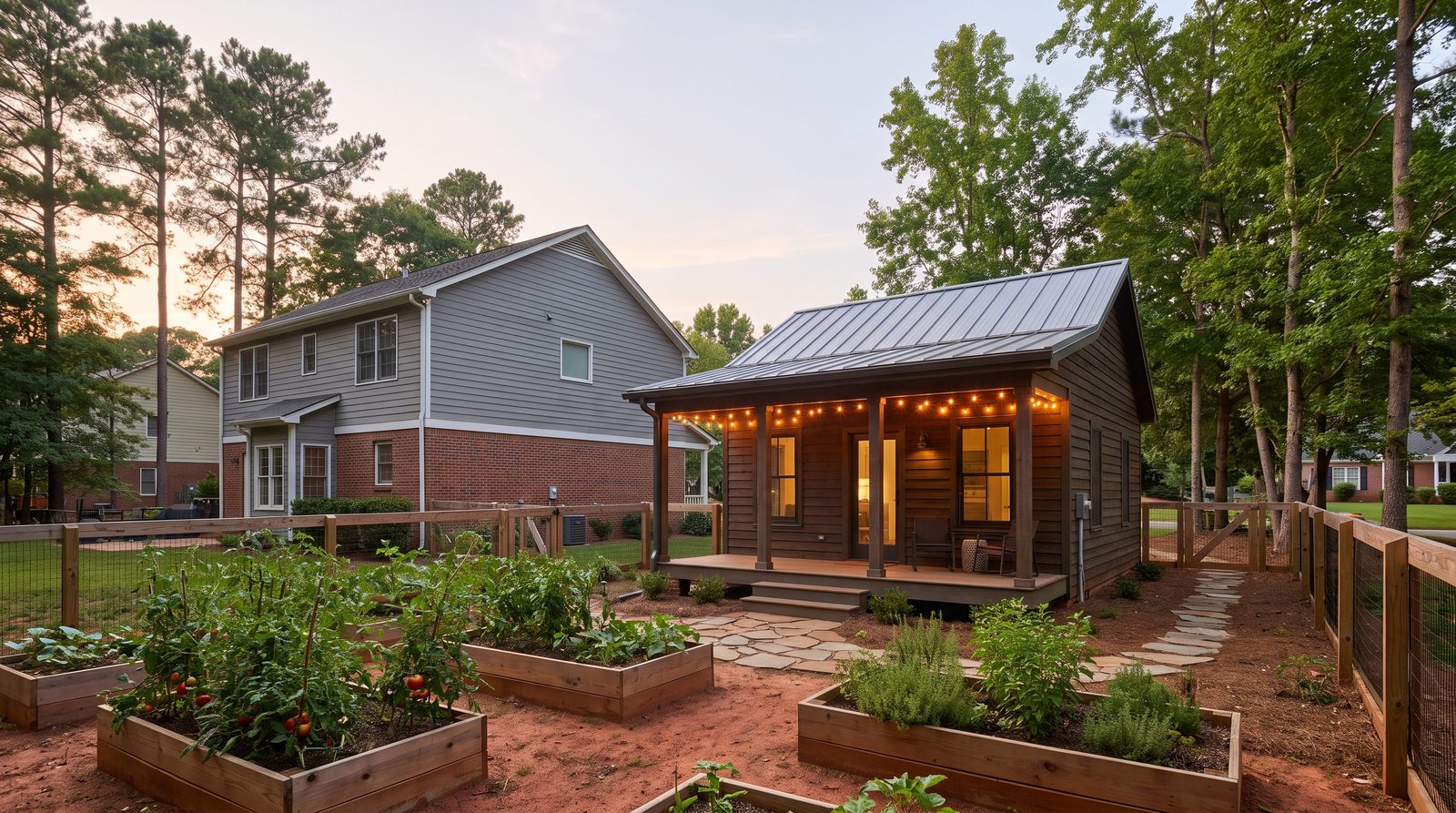
In much of the Triangle, the answer is yes. Raleigh, Durham and unincorporated Wake County already allow accessory dwelling units, or ADUs: a smaller second home on the same lot as your house, such as a backyard cottage, garage apartment or in-law suite. A new state law will require cities of 50,000 people or more to allow one ADU per single-family home for permit applications filed starting January 15, 2027. It does not override neighborhood covenants, and your lot's size, zoning and septic or sewer still matter.
What did the new state law change?
Senate Bill 445, the Regulatory Reform Act of 2026, was signed by the governor on August 11, 2026 and became Session Law 2026-59. Its section 44 adds a new statute, G.S. 160D-917. It says a covered local government must allow at least one ADU that meets the NC Residential Code for each single-family detached home in residential areas where those homes are allowed. The ADU can go up at the same time as the main house or later.
The law defines an ADU as an attached or detached home on the same parcel as a single-family detached house, with less total square footage than the main house. Under the law, covered local governments may not:
- ban long-term rental of the house and the ADU to separate households
- require a conditional zoning district (a custom rezoning)
- set minimum parking requirements or other parking restrictions
- ban hooking the ADU to the main house's existing utilities, if that service has capacity for both
- charge fees above those for permitting a similar single-family home
- set a maximum ADU size below 800 square feet or above 1,000 square feet
They still may require a setback (the distance from the property line) of 10 feet or the district's general setback, whichever is less. They may also require the ADU to sit to the side or rear of the house and to be smaller than it.
The law applies only to cities of 50,000 or more outside the coastal area, and it does not cover counties. It also does not apply to private covenants among owners, properties in a local historic preservation district or National Historic Landmarks. Once an ADU has a construction permit, the lot can't be split to put the ADU on its own parcel. Covered cities must adopt rules by July 1, 2027. If they miss that date, the law says ADUs "shall be allowed in that local government without any limitations." Where a city's current rules differ from the state law, they may change before then.
What are the rules in Raleigh, Durham and Cary today?
Raleigh. The city's ADU page says an ADU can be detached, attached or internal, above a garage or in a basement. A new detached ADU follows the New Single-Family Dwelling permit process, while converting a garage or space inside the house follows the ADU Change-of-Use process. Raleigh's ADU Fast Track program offers an online gallery of plans already checked for building code, which you buy from the designer. The permit helpline is 919-996-2500.
Under Raleigh's zoning code, ADUs are allowed in the R-1, R-2, R-4, R-6 and R-10 districts, one per lot (up to two in a Frequent Transit Area), and not on flag lots. The cap is 1,000 square feet on lots over 40,000 square feet and 800 square feet on smaller lots, with a 26-foot height limit. A detached ADU must sit at or behind the front wall of the house, with side and rear setbacks of 5 feet on lots of 40,000 square feet or less. It also needs a permanent foundation and a lockable outside entrance, and it can't be sold separately.
Durham. The city and county share one zoning code. It allows one attached or detached ADU on a residential lot, with a cap of 1,000 square feet on one story and 1,200 in total (in the RR district, on lots of four acres or more, up to 50% of the main house's floor area), always smaller than the main house. No parking is required. ADUs are not allowed in mapped flood hazard areas, and an RV can't serve as one beyond short visits. The city's Affordable ADU Pilot Program offers construction loans averaging up to about $80,000 at 2% fixed for 30 years. In return, you rent to tenants at or below 80% of area median income for 30 years. You must own and live in a home inside city limits with public water and sewer. Applicants are chosen by lottery. Call Housing and Neighborhood Services at 919-560-4570.
Cary. In 2024, Cary's Act 32 amendment proposed allowing detached ADUs in all single-unit detached districts. It also proposed raising the size limit to 50% of the main house, with an 800-square-foot cap for detached ADUs, and one parking space per ADU. The town lists Council action on April 10, 2025. Ask Cary's planning staff what is in effect today.
What about unincorporated Wake, Apex and Holly Springs?
In unincorporated Wake County, ADUs are allowed on land zoned for single-family or multifamily homes that meets development standards. You don't have to live on the property, and modular or mobile homes can qualify if they meet code and wastewater standards. On septic, an ADU may change your system's design flow, so you may need more wastewater permits. Call 919-856-7434 for septic or 919-856-7482 for wells.
The county's eligibility page says an ADU needs its own kitchen, bathroom and sleeping space, and no extra parking is required. The page explains how to confirm in iMAPS whether your lot is under county planning. The county suggests calling planning at 919-856-6335 before you start.
Holly Springs Update reported the latest state population figures as Apex 75,059 and Holly Springs 49,039. That puts Apex under the new law. Holly Springs Update says Holly Springs is just below the line, until a future state-certified estimate puts it over 50,000. Call each town's planning department for its current ADU rules and to ask whether the new law applies.
What should you check first?
- Find out who has zoning authority over your lot: a city, a town or the county.
- Look up your zoning district and lot size, since both can set your ADU's size.
- Read your covenants. The state law does not override them.
- Ask whether you're on sewer or septic, and whether your system can handle more flow.
- Check for flood zones or a local historic district.
Sources
- Senate Bill 445 / SL 2026-59 bill history · NC General Assembly
- Session Law 2026-59 (S445 ratified text), Section 44 · NC General Assembly · August 11, 2026
- Building an Accessory Dwelling Unit (ADU) · City of Raleigh · July 13, 2026
- UDO Sec. 2.6.3 Accessory Dwelling · City of Raleigh
- UDO Sec. 5.4 Accessory Uses and Structures · City of Durham / Durham County
- ADU Pilot Program · City of Durham
- 2024 - 2025 Act Items (LDO amendments) · Town of Cary
- ADU Frequently Asked Questions · Wake County
- ADU Requirements & Eligibility · Wake County
- NC lawmakers changed the rules for growth. Here's what it means for Holly Springs, Apex and Fuquay-Varina · Holly Springs Update
More on permits and rules

Permits and rules
How to look up a lot's zoning and see how big your house can be
Where to find a lot's zoning in Raleigh, Cary, unincorporated Wake County and Johnston County, and how setbacks, height limits and hard-surface caps shape where your house sits and what you can add.
Permits and rules
Can you build on a Triangle lot with a creek or pond?
How the state's 50-foot stream buffers in the Neuse and Jordan Lake areas shape where a house, septic system and driveway can go, and who decides.