What property tax will you pay on a new home in the Triangle?
How January 1 sets your tax, this year's county, town and fire rates in Wake, Johnston, Chatham and Durham, last year's county rate in Franklin, and when each county plans to reassess values.
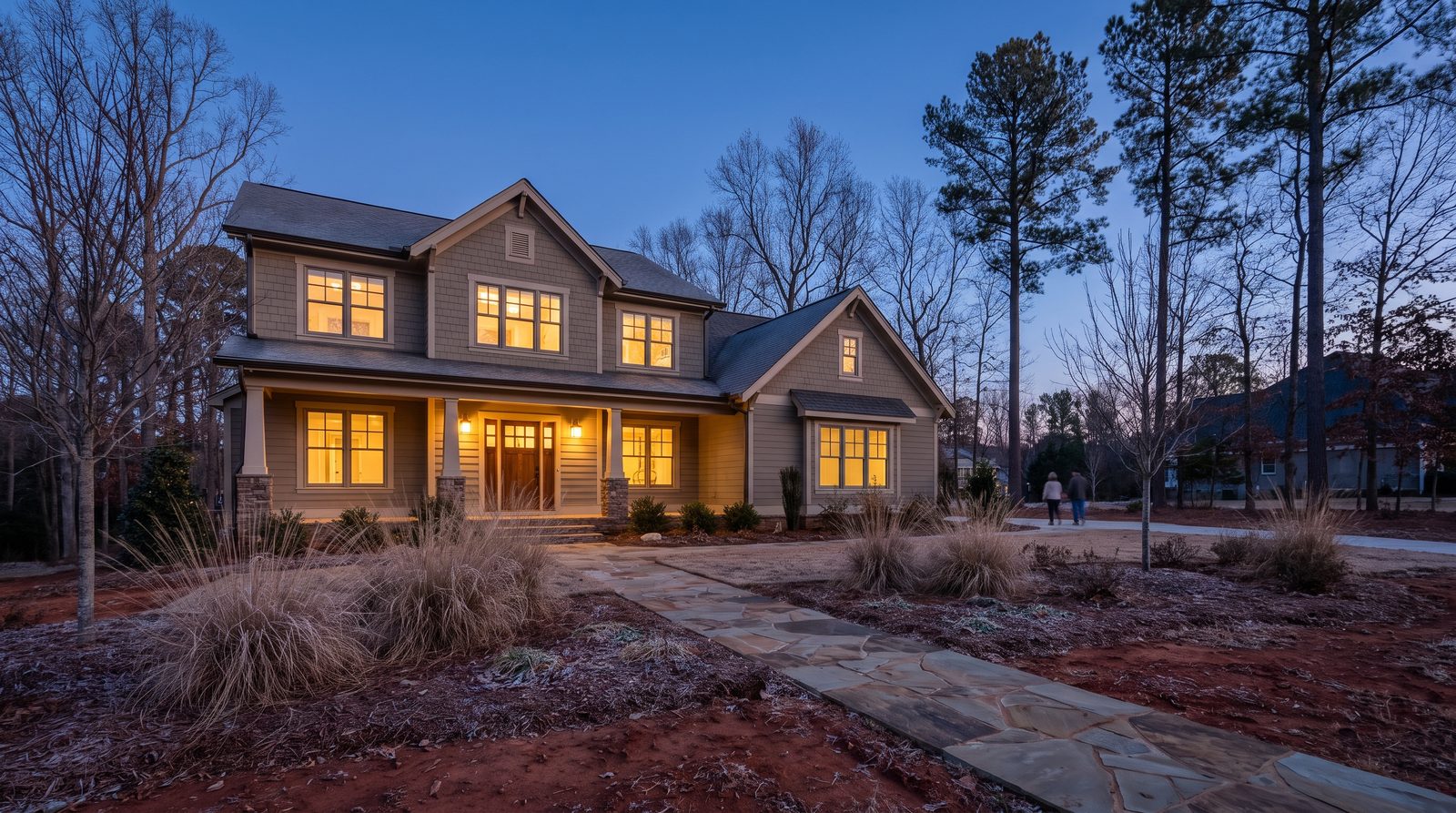
Your yearly property tax is your home's assessed value, divided by 100, times the combined rates that apply to your lot: the county's, plus a town or fire district's, and sometimes a special district's. In North Carolina, value and ownership are set as of January 1, so what stands on your lot that day matters. Wake County reassesses every property on January 1, 2027. The others are not scheduled to until 2029 or 2030.
The same house can cost you hundreds of dollars more or less a year depending on where the lot sits.
How does January 1 decide what you're taxed on?
Under state property tax law, the value of real property and who owns it are fixed as of January 1 each year. In years without a countywide reassessment, the assessor must raise or lower a property's value to reflect a physical change to the land or buildings, like a new house. That change takes effect January 1 of the year it is made and is not backdated. It has to follow the schedules from the county's most recent reassessment.
The same law says that between reassessments, values can't be changed for normal wear, inflation or general market swings. In practice, a finished house is taxed at its value under the last reassessment's schedules, not at today's market price.
If your house will be partly built on January 1, ask your county tax office how it values an unfinished house. Rules for your own situation are theirs to explain.
In Wake, the county says a tax lien (a legal claim for the tax) attaches to real estate on January 1. Owners as of that date must report new buildings or additions from the past year built without a building permit, and county appraisers may visit to measure new buildings.
What are this year's rates in each county?
Rates are stated per $100 of assessed value. Wake's own example: a $200,000 house in Raleigh outside any fire or special district pays a combined .9091 rate (county .5371 plus Raleigh .3720), or $1,818.20, plus a $20 waste reduction fee, for $1,838.20. Town tax in Wake comes on the same county bill.
Wake. The FY 2026-27 county rate is .5371. Some 2026 town rates from Wake's rate chart: Apex .3735, Cary .3675, Holly Springs .3435, Fuquay-Varina .378, Wake Forest .42, Rolesville .40, Garner .535, Zebulon .577. Outside towns, the fire district rate is .1225, and every property in Wendell also pays it. Some towns add fees, such as Rolesville's $315 per unit solid waste fee and Wendell's $120 per parcel stormwater fee.
Johnston. On June 15, 2026, commissioners cut the county rate from 52 to 51 cents per $100 and kept the fire tax at 11.5 cents. The budget also raised the recreation fee in lieu, a charge on new lots, to $1,200 per housing lot from $1,000. The county's tax office says every property is in at least two taxing districts: the county, plus a town or fire district. Clayton's 2026 town rate is .49.
Chatham. Commissioners kept the rate at 60 cents per $100 in the FY27 budget, and Board Chair Amanda Robertson said that, after a property revaluation year, the board "recognized the importance of providing tax relief and certainty for our taxpayers." Six of Chatham's 12 fire districts go up in FY27. Among them: Circle City, which serves Pittsboro, at 11.25 cents; North Chatham at 11.5 cents; Northview at 9.4 cents. The county's tax rates and districts map page helps you find your district.
Durham. The FY 2026-27 county rate is $0.5792, up from $0.5542. The City of Durham adds $0.4371, for a combined $1.0163. Fire district rates range from $0.0470 (Mangum-County Only) to $0.1859 (Durham County Fire/Rescue RTP Special); outside RTP the highest is $0.0919 (Lebanon). The page also lists a $185 solid waste fee.
Franklin. The state's table shows a FY 2025-26 county rate of .5050. Wake Forest, which reaches into Franklin, has a 2026 town rate of .42.
When will your county reassess values?
State law requires a countywide reassessment at least every eight years, and counties may go sooner. The NC Department of Revenue's table, based on county plans as of July 2025, lists the next ones:
- Wake: 2027
- Johnston, Chatham, Durham: 2029
- Franklin: 2030
The department notes that reassessments take effect January 1 of the year shown.
Wake has confirmed its date. Its revaluation FAQ says commissioners voted in March 2025 to move to a two-year cycle. The bill due September 1, 2026 uses January 1, 2024 values. The bill due September 1, 2027 will use January 1, 2027 values and rates set in June 2027. Results go to commissioners January 19, 2027, with value notices mailed that week. After a reassessment, officials must publish a "revenue-neutral" rate, one that would raise about the same money, though they don't have to adopt it.
Who can answer questions about your lot?
- Find your exact districts on your county's map or rate page; a lot just outside a town line pays a fire district instead.
- Use Johnston's estimating method anywhere: value divided by 100, times every rate that applies.
- Call the tax office: Wake at 919-857-3800, Johnston at 919-989-5130. Your lender can explain how the tax fits into your payment.
Sources
- Chapter 105, Article 14 (G.S. 105-285, -286, -287) · NC General Assembly
- Real Estate · Wake County
- Tax Rates & Fees · Wake County
- Tax Rates Current to 2017 (PDF) · Wake County
- Johnston County Adopts Balanced Budget While Reducing Tax Rate… · Johnston County · June 15, 2026
- Tax Bill – Additional Information · Johnston County Tax Administration
- Chatham County Board of Commissioners Approves FY27 Budget · Chatham County · June 16, 2026
- Tax Rates & Districts Map · Chatham County
- Tax Rates · Durham County
- County Property Tax Rates for the Last Five Years (2025-26) · NC Department of Revenue
- Revaluation FAQ (2027) · Wake County
- Estimating Your Property Taxes · Johnston County Tax Administration · July 9, 2026
More on costs and loans
Costs and loans
What does it cost to build a house in the Triangle, and what do families forget?
National and regional build prices, where the money goes, and the Wake, Johnston and Raleigh fees to budget for.
Costs and loans
How does a construction loan work when you build a home in the Triangle?
How construction loans and one-time close loans differ, how the builder gets paid, what FHA, VA and USDA allow, and a North Carolina rule to know.
Costs and loans
How to hook up to city water and sewer near Raleigh and in Johnston County
The steps, offices and rules for connecting a new home to public water and sewer in six Wake towns and Johnston County's system, with Raleigh's 2026–27 connection fees and Johnston County's new monthly rates.