
How to hook up to city water and sewer near Raleigh and in Johnston County
The steps, offices and rules for connecting a new home to public water and sewer in six Wake towns and Johnston County's system, with Raleigh's 2026–27 connection fees and Johnston County's new monthly rates.
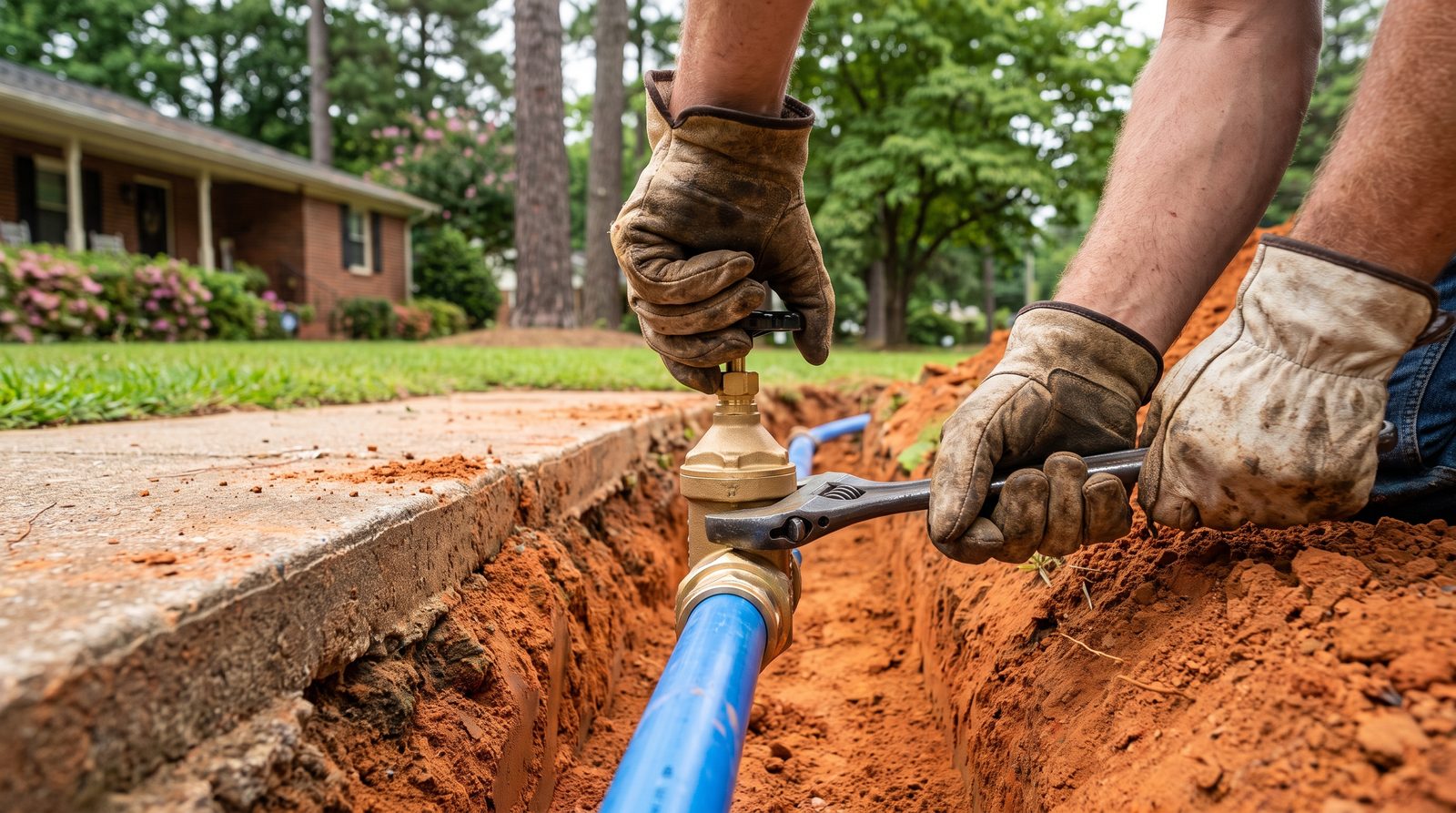
A lot near water and sewer lines is not the same as a lot that can connect to them. In Garner, Knightdale, Rolesville, Wake Forest, Wendell and Zebulon, the City of Raleigh runs the system, and your lot generally has to be inside the town's planning area or annexed into the town. In unincorporated Johnston County, the county's own utility sets the rules, and sewer depends on capacity. Start by asking the utility, in writing, before you count on a hookup.
Can our lot connect at all?
The City of Raleigh supplies water and sewer in Raleigh and in six nearby "merger" towns: Garner, Knightdale, Rolesville, Wake Forest, Wendell and Zebulon. Any project that connects to Raleigh's system goes through plan review and permitting.
A few rules decide whether you can connect:
- Location. According to the city, the property must be inside the town's extraterritorial jurisdiction, or ETJ, which is the area around a town where it handles planning. Outside that area, the lot can't connect unless it is annexed into the town. Your town's planning department can tell you where your lot sits and what annexation involves.
- Water and sewer together. You may be allowed to connect to water only. But if both water and sewer are available, the city says you must connect to both.
- No sewer by itself. Raleigh says sewer-only accounts are not allowed for any new development, including existing lots with no building on them. The narrow exceptions mostly cover existing homes with failing septic systems. For a lot under Wake County's jurisdiction, connecting needs Raleigh City Council approval, and only if a sewer main is directly available.
To ask whether service is available, email water.review@raleighnc.gov with the address, which utilities you want and the size and type of service you need. That answer, not a listing that says "utilities nearby," is what tells you whether you'll need a septic system or well instead.
What do we need before we apply?
The city lists four things you need before you apply for a connection:
- An approved building or plumbing permit. It comes from Wake Forest or Garner if you're building there, or through Wake County's permit portal for Knightdale, Wendell, Zebulon and Rolesville.
- Accepted mains. The water and sewer mains serving the lot must be ones Raleigh Water has accepted.
- An annexation decision, if the lot is outside town limits.
- A valid Wake County address. If you don't have one, contact your town or GIS911addressing@wake.gov.
Then you apply on Raleigh's Permit and Development Portal. Choose PERMITS, then "Request for water and sewer connections in [town name]." For a new home, you attach a plot plan (a drawing of the lot) showing where the water and sewer lines go, plus the recorded map number and lot number. A surveyor or design professional must stamp the plot plan.
The city says it will not make taps (the connection to the main) for new homes; a licensed utility contractor puts them in. Requests are handled with each town within 10 business days. After approval you get a final fee estimate and pay on the portal. Once all inspections pass, you can request your meter and open an account.
What will it cost?
Raleigh's Development Fee Guide covers July 1, 2026 to June 30, 2027. It says Raleigh Water's fees are reviewed and adopted by City Council every year, and some are tied to a construction cost index that rose 2.43% for this fiscal year. Some figures from the guide:
- Water meter: $290 for a 5/8-inch meter (up from $275) and $420 for a 1-inch meter (up from $400).
- Stub inspection: $118 per stub (up from $115) to inspect water and sewer service stubs put in by private contractors.
- City tap fees: $5,756 for a 3/4-inch water service, $6,032 for 1-inch, and $5,155 for a 4-inch sewer service. These are for taps the city installs, and the city says it doesn't tap for new homes in the merger towns. Instead, the fee list has a "stub fee" for contractor-installed taps.
The merger-towns page also lists capital facilities fees, and says they apply when making a direct tap on the main for irrigation or splitting a fire line.
Which of these fees land on your lot depends on your connection, so ask Raleigh Water directly at publicutilityinfo@raleighnc.gov or 919-996-3245. The city's fee calculator gives estimates only; Planning and Development provides the final fee calculation. The permit helpline is 919-996-2500. Your contractor's own charges are separate.
How does it work in Johnston County?
Johnston County Public Utilities says it is not the only water and sewer provider in the county, so first find out who serves your lot. The county's lines appear on its GIS map at johnstonnc.gov/gis2 under the "utilities" layer. Raleigh's fee guide notes that Raleigh treats wastewater for Middlesex and Clayton and sells water to Johnston County, so if you're in or near a town, ask that town too.
For homes outside towns, a county "Residential Sewer Service Policy" sets the rules for using county sewer. The county says all sewer availability "is subject to downstream capacity in the system." Questions about availability go to Rudy Wells, PE, at rudy.wells@johnstonnc.gov. If you're buying in a new subdivision, the county requires water and sewer lines to be installed and accepted before the residential plat (the recorded subdivision map) is filed.
Monthly rates went up on September 1. Commissioners adopted new water and sewer rates on June 15, 2026. Plan review, permitting and inspection fees changed July 1, and rates changed September 1. In the county's example, a home using 4,000 gallons a month now pays $48.00 for water (was $45.80), or $120.00 a month for water and sewer (was $114.20). The county says it now serves about 50,600 retail water customers and more than 9,900 retail sewer customers.
The utility is at the Land Use Center, 309 E. Market Street, Smithfield: main phone 919-989-5075, engineering 919-209-8333, publicutilities@johnstonnc.gov. It posts its fee schedules, a Plan Review Fee Schedule and a Current Active Fee Schedule, where you can look up the connection charges for your own lot.
Sources
- Merger Communities – Permitting for Water and Sewer · City of Raleigh · June 22, 2026
- Sewer-Only Service Connections · City of Raleigh · June 22, 2026
- Development Fee Guide and Calculator · City of Raleigh · July 13, 2026
- Development Fee Guide, July 1, 2026 – June 30, 2027 · City of Raleigh · July 1, 2026
- Private Development Water and Sewer Project Information · Johnston County Public Utilities · June 9, 2026
- Private Development Guidance · Johnston County Public Utilities · June 9, 2026
- Adopted FY 2026/27 Public Utilities Budget and Rate Adjustments · Johnston County Public Utilities · June 22, 2026
More on costs and loans
Costs and loans
What does it cost to build a house in the Triangle, and what do families forget?
National and regional build prices, where the money goes, and the Wake, Johnston and Raleigh fees to budget for.
Costs and loans
How does a construction loan work when you build a home in the Triangle?
How construction loans and one-time close loans differ, how the builder gets paid, what FHA, VA and USDA allow, and a North Carolina rule to know.
Costs and loans
How to get electricity to an empty lot in the Triangle, and who pays for the line
How to find out which utility serves your lot, how to apply for new service, and what two local co-ops' posted rules say about line-extension costs.